

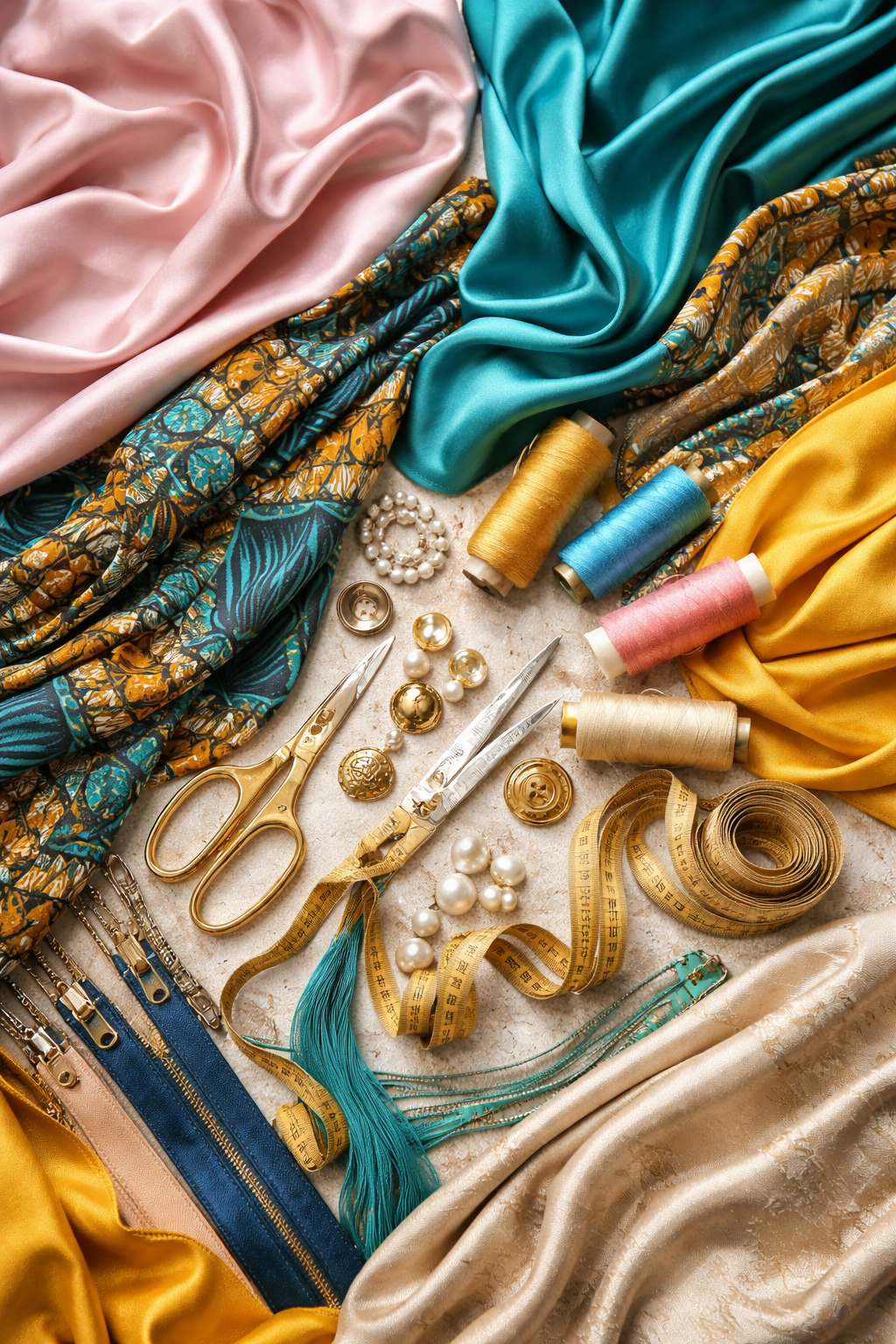
From Atelier to Market: Why Fabric Literacy, Apprenticeship, and Consumer Protection Define a Market-Ready Kenyan Designer
Lately, I have found myself thinking more critically about fabric—its quality, its feel, its truth.
Not in the abstract, but in the very practical, everyday experience of buying clothes. More often than not, purchasing fashion items online feels like a gamble. You are presented with a beautiful image, a compelling price point, and perhaps a vague description—“premium fabric,” “soft cotton,” “luxury blend.” But beyond that, very little. No clear disclosure of the actual fibre composition. No guidance on how the garment should be laundered. No meaningful indication of durability. Even sizing can feel like guesswork.
And so, many of us default back to physical shopping—not out of preference, but out of necessity. We want to touch the fabric, assess its weight, test its stretch, and interrogate its quality in a way that online platforms simply do not enable in our current market. At the heart of this behaviour is not habit—it is mistrust.
And that mistrust is not unfounded.
It speaks to a deeper structural issue within the fashion ecosystem: a disconnect between design, material knowledge, and consumer protection. It also raises a critical question—what does it truly mean for a designer to be market-ready?
The Missing Link: Fabric and Material Literacy
At the core of fashion production is fabric. Yet, paradoxically, many emerging designers have only a superficial understanding of textiles, trims, and accessories. This gap is not accidental—it is systemic.
Kenya is largely an importer of fabrics and fashion inputs. From cotton blends and silks to synthetics, dyes, zippers, beads, and embellishments, much of what is used in local production originates from external markets. This creates a critical vulnerability: designers operate in a market where quality assurance is inconsistent, standards are uneven, and information asymmetry is the norm.
Without proper training, a designer may likely misidentify fabric composition (e.g., polyester blends marketed as pure silk or cotton), use substandard or incompatible materials that compromise durability, fail to anticipate how a fabric behaves over time—shrinking, fading, pilling, or bleeding, or incorrectly advise consumers on care, leading to product damage and reputational risk.
In a global market where consumers expect transparency, traceability, and durability, this is not a minor gap—it is a commercial liability.
Apprenticeship: Necessary but Not Sufficient
Traditionally, apprenticeship has been the backbone of skills transfer in the Kenyan fashion ecosystem. It remains invaluable. A well-structured apprenticeship exposes a designer to hands-on fabric handling and sourcing, real-time problem-solving in garment construction, practical knowledge of trims, fastenings, and finishing and client interaction and product customization.
Critically, apprenticeship can sharpen a designer’s instinct to identify substandard goods—feeling fabric weight, testing strength, observing dye quality, and understanding finishing techniques.
However, an apprenticeship alone cannot carry the regulatory burden of consumer protection.
It is inherently uneven. The quality of training depends entirely on the mentor. There is no standardised curriculum, no certification of competence in textile literacy, and no enforceable threshold for what constitutes adequate training.
This creates a fragmented industry where some designers operate at near-global standards, while others unknowingly produce goods that fail basic quality expectations. This is not great for the purposes of ensuring consistency.
In short, apprenticeship builds intuition—but it does not guarantee compliance, consistency, or accountability.
Consumer Protection: The Silent Gap in Fashion
Unfortunately, the consequences of this gap are ultimately borne by the consumer. In many cases, garments in the Kenyan market lack:
i) Accurate fibre composition labels;
ii) Care and cleaning instructions;
iv) Durability or performance guarantees.
This is not just a branding issue—it is a consumer protection issue.
Under a robust framework, consumers should be able to rely on truthful representations of materials, standardised labelling, safe and durable products, and clear recourse where goods are defective or misrepresented.
Yet enforcement in the fashion space remains weak, fragmented across general consumer protection regimes and standards bodies, without a tailored approach to the realities of the fashion value chain.
The result is predictable: consumer mistrust, designer liability, and a ceiling on the scalability of Kenyan fashion brands. Frankly, I wish Kenyans sued more often. It is my school of thought that through litigation, we also collect data on trends and emerging issues.
The Regulatory Imperative: Beyond Informality
If Kenya is serious about positioning its fashion industry as export-ready, then material literacy and consumer protection must move from informal practice to formal obligation.
There are at least four areas that require urgent intervention:
a) Textile and Material Standards Enforcement
Stronger collaboration with standards bodies is necessary to ensure that imported fabrics and accessories meet minimum quality thresholds. Substandard inputs should not enter the market unchecked.
b) Mandatory Labelling Frameworks
Clear, enforceable labelling requirements should be standard practice, including fibre composition, country of origin (for both materials and finished products), care instructions, and manufacturer or designer identification.
This is not optional in international markets—it is baseline compliance.
c) Designer Capacity Building
Apprenticeship must be complemented with structured training, like textile science basics, material testing and identification, compliance and labelling obligations, and Consumer rights awareness.
This is where institutions, industry bodies, and regulators must collaborate.
Existing consumer protection laws must be operationalised within the fashion sector, with clear liability frameworks for defective or misrepresented goods, accessible dispute resolution mechanisms, and awareness campaigns for both designers and consumers.
Reframing “Made in Kenya”
A persistent misconception is that because Kenya is not a primary manufacturer of many raw materials, its fashion products are somehow less “authentic.”
That position is fundamentally flawed.
Value in fashion lies in design, craftsmanship, assembly, and cultural expression. A garment conceptualised, designed, cut, and constructed in Kenya is unequivocally Kenyan—even if the fabric is sourced globally.
What matters is not origin purity—it is production integrity.
And production integrity is built on knowledge of materials, transparency in representation, and accountability to the consumer.
Market Readiness Is a Legal and Commercial Standard
In conclusion, the future of Kenya’s fashion industry will not be determined solely on runways or social media. It will be determined in the less visible, but far more consequential, intersection of knowledge, regulation, and consumer trust.
A market-ready designer is not just creative—they are informed, compliant, and accountable. This is a tenet of meeting the UN Sustainable Goals number 8 and 12, which respectively address decent work and economic growth and responsible consumption and production.
Apprenticeship will continue to play a vital role, but it must evolve from an informal tradition into part of a broader, structured ecosystem that includes standards, regulation, and enforcement.
Until then, the industry will continue to produce brilliance—but without the consistency required to scale, compete, and command trust in both local and international markets.
And in fashion, trust is everything.

No Comments
Sorry, the comment form is closed at this time.